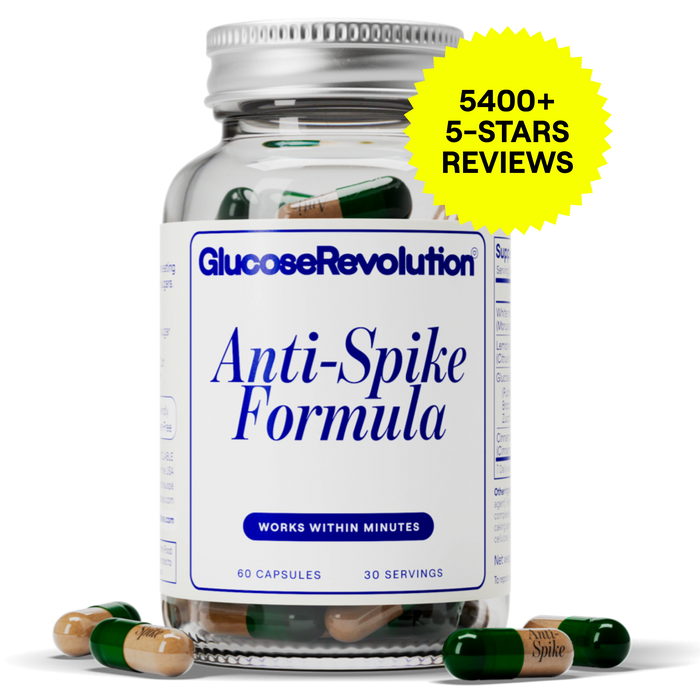


 Anti-Spike Supplement
 Protein Prodigy
 The Recipe Club
 Course
 The 10 Glucose Hacks
 Vinegar
 Alcohol
 Fasting
 GLP-1
GLP-1
 What to Eat Before & After Exercise
 Protein
 PCOS
PCOS
 Menopause
 My MRI Story
 Breakfast
 Supplements
 Clothes on Carbs
 Eggs & Cholesterol
 Chocolate
 Food Labels
 Veggie Starters
 Move After Eating
 Why Glucose Matters
 Glucose Revolution
 The Glucose Goddess Method
 9 Months That Count Forever

SCIENCE GUIDE
Are you ready to take control of your health and manage your A1C levels effectively? Let's dive into everything you need to know about A1C and how you can manage it to maintain optimal health.
CONTENTS
What is A1C?
Snapshot of Sugar: The A1C test measures the amount of glucose (sugar) that has been attached to hemoglobin over the last two to three months. This provides a long-term picture of your average blood sugar levels.
What is an A1C Measure Test?
The A1C test is a blood test that provides information about a person's average levels of blood glucose, also called blood sugar, over the past 3 months. This test is important because it helps to diagnose diabetes and to see how well your blood sugar levels are being managed. For people with diabetes, the A1C test measures how well they are managing their blood glucose levels over time.
The Risks of a High A1C Level
High A1C levels can indicate that your average blood sugar levels have been high over the past two to three months, which is a sign of unmanaged diabetes. Here are some risks associated with high A1C levels:
- Feeling Thirsty and Going to the Bathroom a Lot: You might notice you need to drink more water and use the restroom more often.
- Feeling Really Tired and Blurry Vision: High glucose levels can make you feel exhausted and affect your eyesight.
- Slow Healing of Cuts and Sores: High sugar levels in the blood can slow down the healing process.
- More Infections: You might get infections more easily.
- Numbness or Tingling in Hands and Feet: This can be due to nerve damage from high glucose levels.
Video transcription : You CAN Beat Diabetes & Insulin Resistance: Simple Hacks to Reverse It NOW! | Episode 8 of 18
...and the hacks that I'm sharing, they don't ask you to cut out the carbs that you love. This is so important, I want to repeat it. They don't ask you to never eat sugar or pasta or bread again. They're just going to show you how to eat your carbs in a way that's also going to help pour your type 2 diabetes into remission.
Hello angels, and welcome to the Glucose Goddess Show. I'm Jessie Inchauspé, I'm a French biochemist and I'm here to teach you about your body.
In today's episode, we're going to cover insulin resistance, pre-diabetes, type 2 diabetes. I'm going to break some myths, I'm going to give you tips to reverse those conditions easily and without too much pain or complication. I'm really excited to get started with this topic, so let's do it.
Okay, first things first. Type 2 diabetes is a global epidemic. The International Diabetes Federation, they publish numbers every year, and they have found that 537 million adults in the world are now living with type 2 diabetes and another 541 million are living with pre-diabetes. These numbers are getting worse every single year. So right now, 1 billion people in the world have either type 2 diabetes or pre-diabetes, and as I'm going to explain, this is all linked to insulin resistance.
We need to do something about this. This is because of the food environment we live in. We need more regulation in food supply, food companies, but we also need to be educated so that we can figure out how to navigate this difficult landscape that is causing these issues.
So you may have diabetes, you may know somebody who has diabetes, you may have insulin resistance, you may have pre-diabetes or know somebody who does. This information is going to help you.
The first thing you need to know is that these conditions are not genetic, okay? Type 2 diabetes is not something that you are born with. It's not something that you cannot do anything about. It is something that is the consequence of the way you're eating and the way you're living, and it's not your fault, okay? The odds are stacked against you. All of the food accessible today is making our health worse and increasing this diabetes number worldwide.
I'm going to give you information that's going to help you actually be able to navigate this complicated landscape. And how do we know that type 2 diabetes is not genetic? We have a few different proofs.
First of all, type 2 diabetes used to be called adult-onset diabetes. It was called that way because only adults would get it. Well, today 5-year-old children are getting this condition, when that was not the case at all, and our genes have not changed so much. What has changed is what we're eating and the food environment. So that's clue number one.
Clue number two: we know from scientific studies that identical twins, so people who have the exact same DNA to the letter, well, if one twin has type 2 diabetes, the other twin might not necessarily have it. It's not like both twins always have it or both twins always don't have it. It is due to other factors. So that's another really important clue that one identical twin can have type 2 diabetes and the other one cannot have it. That means it is not 100% genetic.
And finally, and I think for me the most compelling piece of evidence, is that hundreds of studies have shown us that if we change the way that we eat, we can put our type 2 diabetes into remission. Now, this is the key. If you've been diagnosed with diabetes, your only option is not to take medication for the rest of your life. If you're willing and if you're able to change how you're eating, you can put this condition into remission.
Now, I know that for a lot of people it's really hard to fathom changing how we're eating and our food habits, and it seems like something that is way too complicated and out of reach. But don't worry, the stuff I'm going to share with you today is actually simple and you'll be able to do it. It's not a complicated diet, it's not super restrictive, it doesn't ask you to buy $35 smoothies. We're here for practical, easy tips.
But first, before we get into all of the ways to solve it, I want to give you guys a little biology recap, biology 101, on what is insulin resistance and what is type 2 diabetes.
The most important thing to remember, that I think probably you might not know yet, is that insulin resistance is a spectrum, and so we can measure how insulin resistant anybody is at any moment. You can measure me, you can measure yourself, you can measure your mom, your sister, your friend, your colleague. You can measure insulin resistance at any given moment.
When you're not insulin resistant, you're called healthy. When you get more insulin resistant, you're called pre-diabetic. And when you get really insulin resistant, then you're called type 2 diabetic, then you have type 2 diabetes. So insulin resistance and its spectrum is what underpins whether or not you have a diagnosis like pre-diabetes or type 2 diabetes. So if you've been diagnosed with insulin resistance, well, that means that you're somewhere in that spectrum, maybe you're getting a little bit close to pre-diabetes.
So insulin resistance moves. You can become more or less insulin resistant depending on how you're living, and the objective is going to be to become less of it.
So let's back up even more. What the heck is insulin? Why do we care? What is this insulin resistance thing?
Okay, so first things first. Before we talk about insulin, we have to talk about glucose. Don't worry, it's going to be easy. Glucose is your body's favorite source of energy, okay? Every single part of your body, like my fingers that I'm moving right now, my mouth that I'm using to speak to you, your brain as you're listening to me, they're all burning glucose for energy. It's the most important fuel in your body.
And the way that you give glucose to your body so that you can have energy is by eating foods, specifically by eating two types of foods: by eating starches — so that's bread, pasta, rice, potatoes, oats — and by eating sugars. By sugars I mean anything that tastes sweet, from an apple to a slice of chocolate cake.
So when we eat these starches or these sugars and they go into our mouth, they then break down into glucose because they contain glucose. So when you eat starches or sugars, they're going to increase your glucose levels in your body. And after a meal, if you ate a lot of those foods — and by the way those foods are called carbs, generally starches and sugars are called carbs — if during a meal you eat a lot of carbs, then you're going to experience what's called a glucose spike. That means just a quick delivery of glucose to your body, and you could actually see this if you were measuring your blood: you would see a big spike like the one on this graph right here.
So glucose spikes are a problem. They make us tired, they make us have cravings, they inflame our body and, most importantly for our conversation today, they lead to your body sending out insulin.
Why does your body respond to glucose spikes with insulin? Because your body knows that big glucose spikes are not good for it, and so it calls your pancreas and it's like, "Hey pancreas, can you please send out some insulin to get that glucose spike down?" So insulin arrives and grabs all the excess glucose and stores it away in your liver, in your muscles and in your fat cells.
So you might be wondering: well, how is it possible that if glucose is the energy of my body, how is it possible that I could give my body too much of it? Well, it's a bit like a plant. So this plant on my desk right here, I know that it needs some water to live and survive. But if I give the plant too much water, then it's going to drown and die. And the human body is the same: some glucose and it's really happy, but too much glucose and problems start happening, notably these glucose spikes.
So after a meal, lots of carbs, big glucose spike happens in your body. Insulin comes in, grabs all the excess glucose and stores it away into your cells. So far so good.
Okay, now let me tell you a little story about when I was a student, because I have to explain this next part. So I grew up not drinking any coffee, and then I moved to London and I was studying mathematics and I had my very first coffee. And let me tell you, that very first coffee of my life kept me awake for a very long time. I had a super hard time going to bed that night. I was wired, it was crazy.
Now, I started getting used to drinking coffee, and then three months later I needed like three cups of coffee a day just to stay awake. And I wondered, what's going on? How is it possible that just a few months ago one cup of coffee was keeping me awake for days basically, and now I need three cups just to wake up in the morning and go to class?
Well, what happened was that my body got used to the coffee. My body gradually became resistant to the coffee, so I needed to give my body more and more coffee to get the same effect.
Well, with insulin, the same thing happens. When there's lots of insulin in your body for a long time, your body slowly becomes resistant to insulin. Just like with the coffee, it needs more and more insulin to do the same thing, and in this case it needs more and more insulin to grab that glucose and store it away in your cells.
So your body starts producing more insulin. But just like with coffee, if you start drinking more and more coffee, you're going to become more and more resistant to it and you're going to need more and more of it. It's kind of a vicious cycle. In your body, it's the same thing. Over time, maybe a few months or years later, you're going to need so much more insulin to get that glucose out of circulation and into your cells. Your body will have become resistant to the insulin. That is insulin resistance in a nutshell.
Now, what's the consequence? So let's say you keep eating the same way you've been eating. So you're eating carbs and they're increasing your glucose levels and you're giving too much glucose to your body, but maybe you don't know it. Well, after a while, because of this insulin resistance, insulin is just not working very well anymore and it's not able to grab all the excess glucose and store it away. So your glucose levels in your blood, they start to rise because the excess glucose is not being disposed of as easily as before. Your glucose levels in your blood start to rise and start to increase.
And that is what is measured at the doctor's office once a year. Your doctor measures what's called your fasting glucose level. Basically, your doctor tells you to come into the doctor's office first thing in the morning and the doctor measures the amount of glucose in your blood.
Now, if you're eating in a way that's not causing too many glucose spikes, you don't have a lot of insulin in the body, you're not very insulin resistant, your fasting glucose is going to be normal, healthy. It's going to be like 85 or 90. But if you've been eating in a way that causes glucose spikes for a long time — therefore there's a lot of insulin in your body, therefore your insulin resistance, therefore glucose is rising — your doctor might notice that your fasting glucose level is high.
And here are the ranges that your doctor is going to look at. Your doctor's going to look at the number. So if your fasting glucose number is underneath 100, your doctor's going to tell you you're healthy, you don't have pre-diabetes, you don't have diabetes. If your fasting glucose number is between 100 and 126, your doctor is going to say, "Oh, you're pre-diabetic." And if your fasting glucose level is above 126, your doctor is going to say, "You have type 2 diabetes."
And again, this is just a way of explaining how insulin resistant you are, because if you have high glucose level, you also have a lot of insulin resistance in your body. They go hand in hand.
In some countries, that number uses a different unit, the fasting glucose number. So instead of using milligrams per deciliter, you might be using millimoles per liter (mmol/L). And if you're using millimoles per liter (mmol/L), you want your fasting glucose level to be underneath 5.5 to be normal. It's just a unit thing, it's like kilos and pounds, but it's the same concept.
Now, why does it actually matter if you have a lot of fasting glucose level? Why is type 2 diabetes an issue? What's really going on?
Let me take you on a little trip. Let's go see — I have sugar cubes here to show you guys. So what's really interesting is that in the body of a person who has normal fasting glucose level, so healthy, this is the amount of sugar, of glucose, circulating in their body. It's just one sugar cube. It's really not that much.
Now, if somebody has type 2 diabetes, do you know how much sugar they have circulating in their bloodstream? One sugar cube and a half. The difference is tiny between a healthy person and someone with type 2 diabetes. This seems like no big difference, right? This seems like, okay, well it's just a tiny, tiny increase in how much glucose is circulating in your body between being healthy and having type 2 diabetes.
But the thing is, this has huge consequences. That tiny little increase in how much glucose is circulating is going to hurt your cells, it's going to inflame your body, it's going to hurt your brain, it's going to create glycation, it's going to cause a whole bunch of issues. And long term, if you've had type 2 diabetes for a long time, this can also lead to things like amputation. I mean, this is a serious condition and we want to get that amount of glucose in your blood down so that you don't suffer the consequences.
So that was the recap. Insulin resistance is a spectrum. If you have pre-diabetes or type 2 diabetes, that means your insulin resistance is not great and it's pretty bad.
I know most doctors still run just the fasting glucose test, but actually a better test is to run your fasting insulin level. That is going to give you a sense of your insulin resistance, because insulin levels, they start rising for years before your glucose levels rise. So if you want to detect insulin resistance and diabetes earlier, measure your fasting insulin levels.
In the description of this episode, I have a one-pager that recaps all these ranges, all these tests that you can run, etc., so that if you want to have this all in one page and show your doctor, you can. So have a look at the link in the description of this episode.
Now, if you have insulin resistance or type 2 diabetes, you might also have other things that are related to all of this, like polycystic ovarian syndrome or fatty liver disease. So what do you do if you have these conditions?
Well, as I explained, it's all because there's too much insulin in your body. So we need to get that insulin down so that we get that fasting glucose level down. We need to give less glucose to our body, essentially, so that your body doesn't need all this insulin and can slowly reduce how much it's producing.
So how do we give our body less glucose? Well, listen, the most important place to start is to look at these carbs, because the carbs are what turn to glucose as we digest them. So have a look at how you're eating. Are you eating mostly starches and sugars? Are you eating mostly bread, pasta, pizza, sodas, granolas, fruit juices, candy? If that's the case, you're giving a lot of glucose to your body all the time.
There's another free thing in the description of this episode — I have lots of stuff I'm going to give you. It's a big table that recaps what are starches, what are sugars (those increase your glucose levels) and then what are proteins, fats and fibers (and those do not increase your glucose levels), and those are the ones that you want to eat more of, and eat less of the carbs.
So for example, if you're used to having in the morning a slice of toast with some jam on it and an orange juice, that's basically 100% carbs. That's going to lead to a lot of glucose and it's going to make your diabetes or your insulin resistance worse. An alternative is to have something like a hot tea and some soft-boiled eggs with a little bit of sea salt on them, or even a ham sandwich is going to contain less carbs than all of the other sugary stuff that I just mentioned. But have a look at the food classification master list in the description of this episode to get started.
But essentially, you can totally do something about your insulin resistance and your diabetes. It's not a life sentence. It's not something you're born with. It's something that you are impacting with the way that you're eating every day.
And if you're wondering about the science, there's a really interesting 2021 review that made it very clear that the best way to reverse type 2 diabetes is to flatten your glucose curves, is to avoid those glucose spikes. The study was called "Efficacy and Safety of Low and Very Low Carbohydrate Diets for Type 2 Diabetes Remission: Systematic Review and Meta-analysis of Published and Unpublished Randomized Trial Data," and in this study they saw that diabetes remission was observed in over 57% of participants at 6 months.
And we have so much evidence today that now even the American Diabetes Association started endorsing diets that lead to smaller glucose spikes as a really helpful way to put your diabetes into remission. This is your core option. It's the most important thing: to try to update how you're eating to get those glucose levels and insulin levels down.
So let's go over my glucose hacks that are going to help you get there in a really easy way. And before we start, I just want to show you something. So over the past few years, I've been synthesizing all the latest scientific data into these 10 core principles that help get those glucose levels down and help you put your diabetes or insulin resistance into remission.
And in my second book, The Glucose Goddess Method, what I did is that I recruited 3,000 people to follow my hacks for four weeks and I measured the impact. And just to show you something, I asked them how it was going and I got a lot of data from them. There were a lot of people who joined who had type 2 diabetes or insulin resistance, and in these four weeks, by just adding four really simple tips, four really simple hacks, 41% of people saw an improvement in their diabetes.
And these hacks are incredibly easy. We're talking about: have a savory breakfast instead of a sweet one, add vinegar once a day before a meal, add veggie starter to one of your meals — lunch or dinner — and go for a 10-minute walk after one meal a day. We're not talking about intense calorie counting. I'm not talking about super hardcore diets that you're never going to be able to follow.
We need to find solutions that are easy, that integrate into your life, that allow you to still eat the carbs that you like, okay? Still eat those starches and sugars with less impact on your glucose levels.
So in the description of this episode, you can click and download a free one-page PDF summary of my 10 core glucose hacks. This is going to help you get started putting your type 2 diabetes into remission or your insulin resistance into remission.
I really want to leave you with this key piece of information: these conditions are not genetic or something you're born with or something that you can't do anything about. You have control, you have agency. It doesn't have to be too complicated. I know that change sometimes feels overwhelming, but these 10 hacks — have a look at them — I think you're going to find them simple and life-changing.
And if you want even more help to get started, I have lots of stuff to help you. I have my two books: Glucose Revolution, The Glucose Goddess Method, with lots of recipes in The Glucose Goddess Method. I have my recipe club that gives you motivation and super simple recipes every single month to keep your glucose levels steady. And on top of all of this, I have thousands and thousands of readers and people in the community who have successfully put their type 2 diabetes into remission using my hacks.
I'm going to read you a few of their testimonials, actually. First testimonial:
"I had type 2 diabetes. I had previously been told by my dietitian that because I have celiacs as well as diabetes, adjusting my metabolism would be like adjusting the course of an oil tanker. But I noticed results with this method within 4 days."
Yeah, change can happen really fast. And by the way, if you're on medication, tell your doctor you're going to apply the hacks, because they can completely transform your glucose levels in a matter of days.
"I continued beyond the 4 weeks and my HbA1c dropped in 4 months from 9.6 to 4.7." HbA1c is another way to measure diabetes. The person says, "I'm no longer diabetic at all and I lost 25 kilos. This should be available through the government for anyone with pre-diabetes and diabetes."
Here's another one I want to share:
"I have type 2 diabetes. Mentally I'm so much more motivated because I have energy and feel so much more positive. Physically, my blood sugar has not been climbing as high post meals and I have been able to reduce the amount of insulin I need too. This has had a massive impact on my moods. I'm less irritable and I have so much more energy."
This could 100% be you. So have a look at the hacks, have a look at my method. It's simple, it's easy, thousands of people have seen improvements and you have control, you have agency.
And the hacks that I'm sharing, they don't ask you to cut out the carbs that you love. This is so important I want to repeat it. They don't ask you to never eat sugar or pasta or bread again. They're just going to show you how to eat your carbs in a way that's also going to help pour your type 2 diabetes into remission.
And then more globally, because this crazy epidemic of diabetes has been created because of our food landscape and the food companies pushing addictive carb-heavy products to us and we've become the victim of this situation, we also need regulation. We need food companies to not be able to advertise all this crazy carb-heavy ultra-processed foods to kids, for example, so that we help kids who are 5 years old not get type 2 diabetes at that age.
Both things have to change. We need to be more educated and we also need to push on the industry so that a lot of their practices change and update so that we don't get so sick anymore.
So in any case, that's all we have time for today. I hope that was helpful. If you've just got a diagnosis or if you've had it for a long time and you want to start improving, it's totally possible. Have a look in the description of this episode for all the free resources you need to get started.
And I'm with you. This is one of my passions: helping people with type 2 diabetes understand their condition and getting control of it. So I'm hoping that you'll find some inspiration, hope, motivation in this. It's possible, you're not alone, I'm here for you.
Good luck and let me know how it goes.
High A1C levels can indicate that your average blood sugar levels have been high over the past two to three months, which is a sign of unmanaged diabetes. Here are some risks associated with high A1C levels:
- Feeling Thirsty and Going to the Bathroom a Lot: You might notice you need to drink more water and use the restroom more often.
- Feeling Really Tired and Blurry Vision: High glucose levels can make you feel exhausted and affect your eyesight.
- Slow Healing of Cuts and Sores: High sugar levels in the blood can slow down the healing process.
- More Infections: You might get infections more easily.
- Numbness or Tingling in Hands and Feet: This can be due to nerve damage from high glucose levels.
What is Hemoglobin?
Oxygen Carrier: Hemoglobin is a protein in your red blood cells that has a very important job. It picks up oxygen from the lungs and delivers it to all the parts of your body that need it. After delivering oxygen, hemoglobin picks up carbon dioxide, a waste product from your cells, and carries it back to your lungs. When you exhale, you breathe out this carbon dioxide.
Glycation Explained
- Sugar Coating Process: When sugar in your blood sticks to hemoglobin, this process is called glycation. Imagine your hemoglobin as a sponge absorbing sugar. The more sugar in your blood, the more gets soaked up by the hemoglobin. This "sugar coating" is measured by the A1C test.
- Why It Matters: The level of sugar-coated hemoglobin gives a snapshot of how high your blood sugar has been on average. A higher "sugar coating" means higher blood sugar levels, which can be harmful over time, leading to potential health issues if not managed properly.
Different Names for A1C Around the World
This test might be called HbA1c, hemoglobin A1C, or simply A1C, depending on where you are. No matter the name, it's essential for monitoring and managing diabetes globally.
How to Test Your A1C: Lab Tests vs. Home Kits
Professional vs. DIY: Get a detailed analysis at a lab or check conveniently at home with a kit. Both methods will help you monitor your diabetes but offer different levels of convenience and precision. Just like regular car maintenance helps prevent breakdowns, monitoring your A1C helps prevent long-term health complications by keeping your diabetes under control.
Interpreting A1C Results
- Below 5.7% (Excellent): Your blood sugar management is on point—keep up the good work!
- 5.7% to 6.4% (Pre-diabetes): Like a yellow light, it's time to slow down and make changes to prevent diabetes.
- 6.5% or Higher (Diabetes): This is a red alert, indicating that your current management plan needs adjustment to better control your diabetes.

Lifestyle Changes for Better A1C
Managing Your Health: Change what you eat, increase your physical activity, and talk to your healthcare provider about your medication. It's about taking care of your health from all angles, like maintaining a complex machine.
By understanding and managing your A1C levels well, you can reduce the risk of diabetes-related complications and maintain a healthier lifestyle. Regular checks, smart lifestyle choices, and proactive healthcare are key to keeping your blood sugar levels stable.
Additionally, I have developed a free guide that details three essential blood tests you should consider running, alongside A1C. This guide explains each test thoroughly and demonstrates how they contribute to a comprehensive view of your health.
Click the button below to access the guide and start taking control of your health today.
How to Lower Your A1C Levels
Managing your A1C doesn't have to be complex. Start with my Glucose Hacks that have helped many achieve better blood sugar control effectively and enjoyably:
- Eat Foods in the Right Order: Begin your meals with vegetables, then eat proteins and fats, and finish with starches and sugars. This order slows down the absorption of glucose.
- Add a Veggie Starter: Start one meal a day with a vegetable-based dish. The fiber in veggies helps reduce glucose spikes.
- Apple Cider Vinegar: Taking a tablespoon of apple cider vinegar in water before meals can help improve insulin sensitivity and lower blood sugar levels.
- Have a Savory Breakfast: Instead of sweet foods, opt for a breakfast high in protein and healthy fats, like eggs and avocado. This helps prevent morning glucose spikes.
These hacks are just the start! For a complete list of ways to manage your blood sugar effectively with everyday actions click the button down below 🔽
Alongside these hacks, here are some additional strategies that complement them well:
- Watch Sugars and Starches: Be mindful of the sugars and starches you eat. Choose options that won't spike your glucose levels and pair them with proteins or fats.
- Drink Water: Staying hydrated helps your kidneys flush out excess sugar through urine.
- Regular Exercise: Stay active with a mix of cardio and strength training. A simple walk or light exercise after meals helps your body use glucose more efficiently.
- Supplement Support: Consider using supplements like Anti-Spike, which contains ingredients specifically chosen to help smooth out blood sugar fluctuations and support overall metabolic health.
By using these hacks every day, you'll not only lower your A1C but also improve your overall health. Start with these easy changes and create a lasting way to manage your blood sugar levels.
Meet Anti-Spike: Your Secret Weapon in A1C Management
Managing your A1C levels just became more manageable with Anti-Spike, a carefully formulated supplement designed to smooth out the troublesome blood sugar spikes that can influence your A1C. Since A1C reflects your average blood sugar levels over several months, maintaining steady levels is crucial for good health outcomes.
Key Components of Anti-Spike

- White Mulberry Leaf: Slows down the breakdown of sugars in the gut so that they are absorbed more slowly into the bloodstream.
- Lemon Extract: Works to modulate blood sugar levels, reduce inflammation, and enhance feelings of satiety.
- Cinnamon Extract: Helps in managing insulin levels and improving insulin sensitivity, making it easier for your body to manage natural sugar intake.
- Blend of Antioxidant-rich Vegetables: Supplies a concentrated dose of antioxidants that support overall cellular health and help manage the oxidative stress associated with blood sugar fluctuations.
Integrating Anti-Spike into Your Routine

- Daily Support: By adding Anti-Spike to your daily regimen, you’re giving your body extra help in managing blood sugar levels effectively.
- Long-Term Benefits: Regular use of Anti-Spike can lead to more stable blood sugar levels, helping to maintain healthy A1C levels and improving overall diabetes management.
- Easy to Use: Whether it's taken with meals or as part of your morning routine, Anti-Spike is designed to fit seamlessly into your lifestyle.
Why Choose Anti-Spike?
- Targeted Action: Each ingredient in Anti-Spike is selected for its specific benefits in controlling blood sugar, offering a targeted approach to managing blood sugar.
- Comprehensive Support: Beyond just managing blood sugar, Anti-Spike supports overall metabolic health, contributing to better energy levels and general well-being.
If you’re looking for a reliable way to support your A1C goals, consider making Anti-Spike a part of your daily health plan. It’s like having a dedicated helper focused on keeping your blood sugar balanced throughout the day.
Final Thoughts on Managing A1C
Managing your A1C levels is more than just about watching what you eat and exercising. It's about making simple, lasting changes that fit into your daily life. By eating balanced meals, staying active, and using supplements like Anti-Spike, you can keep your blood sugar levels steady and feel better overall.
This approach gives you the tools and knowledge to keep your A1C levels healthy, making your life better. If you're unsure about what to do next, talking to a healthcare provider can give you personalized advice and support. Let's take this journey together, making everyday choices that lead to better health and happiness.


